
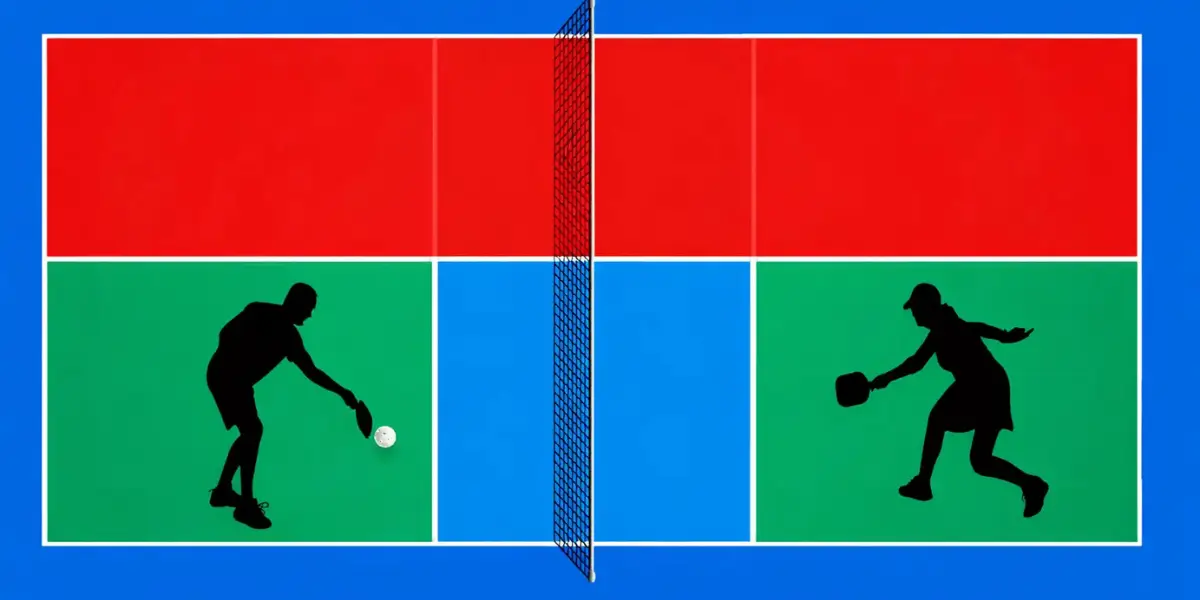
What is skinny singles in pickleball, and why do so many players use it to sharpen their skills faster than regular singles? Skinny singles is a half-court version of singles where each player defends and attacks from only one side of the court.
The ball must travel crosscourt, which forces precision, smart placement, and disciplined movement. This format strips away unnecessary running and exposes weaknesses in control, footwork, and shot selection.
You will learn exactly how skinny singles works, the rules players follow, the variations you can try, and why it has become one of the most effective training methods in modern pickleball practice.
How to Play Skinny Singles in Pickleball
Skinny singles follows traditional singles rules but limits each player to one half of the court. That single adjustment changes movement shot selection and point construction.
Step 1: Choose Court Side
Before the first serve, both players decide which half of the court will remain active. Most games use a crosscourt setup where each player stands diagonally opposite the other. If you start on the right side, your opponent also plays only their right side across from you.
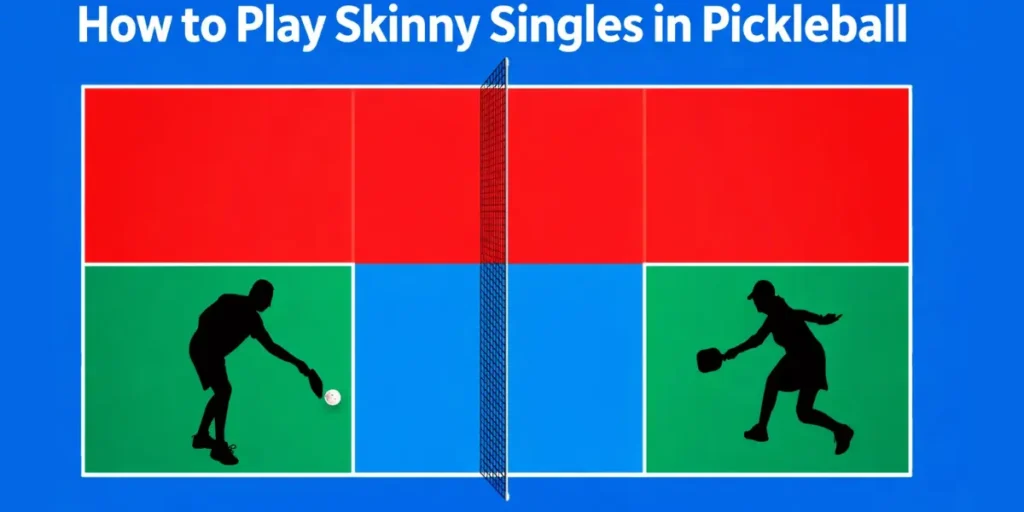
Once the rally begins, you stay on that assigned half. You do not switch sides after scoring. This fixed positioning creates repetition, which sharpens directional control and movement patterns. Many players rotate sides after several games to develop both forehand and backhand sequences.
Step 2: Follow Standard Pickleball Court Rules
Skinny singles uses the official court dimensions defined by USA Pickleball. The court remains twenty feet wide and forty-four feet long, though only half the width is playable.
The non-volley zone stays fully active. Kitchen violations still apply, and the two-bounce rule remains in effect. Keeping official rules intact ensures that habits developed here transfer directly into competitive play.
Step 3: Serve Diagonally
The serve follows standard singles mechanics. You strike underhand with paddle contact below the waist and send the ball diagonally into the correct service box within the active half.
Scoring begins at zero, zero two, and only the server earns points. Depth matters more than speed. A deep serve sets up a controlled third shot and establishes early pressure.
Step 4: Rally Crosscourt Only
After the return, every shot must remain inside the chosen half. Any ball that crosses into the unused half counts as out.
This rule forces discipline. Players must construct points through controlled angles, consistent depth, and patient exchanges rather than risky winners.
Step 5: Play to 11 Win by 2
Skinny singles typically follow standard singles scoring. Players compete to eleven points and must win by two. Only the serving player can score, which places added pressure on service games and rewards focus.
Because the court space is reduced, each rally carries weight. There is less room to recover from poor positioning or careless execution.
Players who control depth, protect the non-volley zone line, and avoid rushed attacks tend to win consistently. Patience and precision matter more than power in this format.
Skinny Singles Pickleball Rules Explained
Now that you understand how to play skinny singles, it becomes important to clarify the exact rules that keep the format structured and competitive.
Court Boundaries
The full court dimensions remain unchanged according to USA Pickleball guidelines. The court measures twenty feet wide and forty four feet long, though only one-half of the width becomes active in skinny singles.
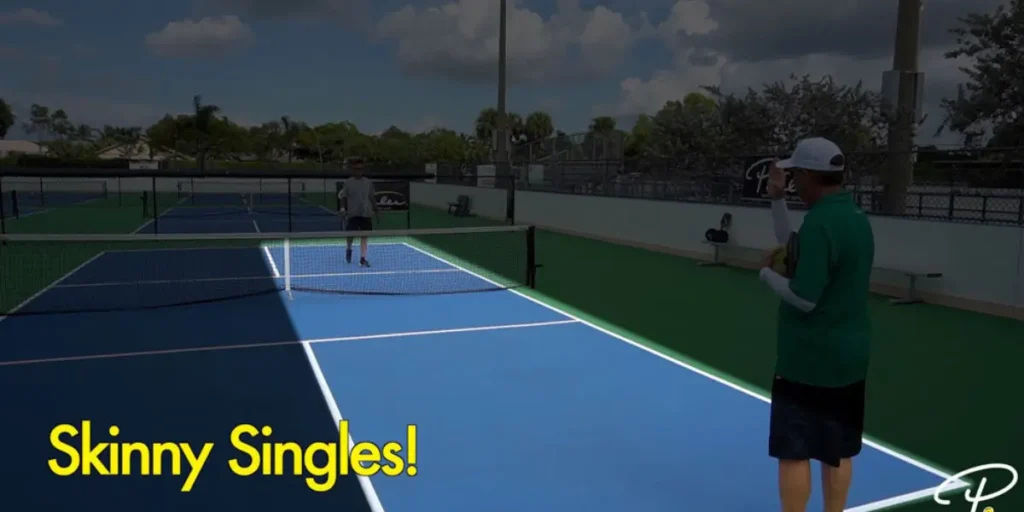
In the standard cross-court version, each player uses the diagonal half in front of them. Any ball that lands outside that designated area counts as out, even if it would be legal in full pickleball singles. This restriction demands precise directional control.
There is no extra space to recover from poor placement, which makes accuracy essential on every rally ball.
Serving Rules
Serving mechanics follow official singles standards. The serve must be struck underhand with paddle contact below the waist and travel diagonally into the correct service box within the playable half.
The two-bounce rule remains in effect. The serve must bounce, and the return must bounce before volleys are allowed. By keeping these fundamentals intact, skinny singles reinforces proper match habits instead of encouraging shortcuts.
Scoring System
Scoring mirrors traditional singles, and only the server earns points. Games usually go to eleven and require a two-point margin. Players alternate service positions within their assigned half after each point won on serve.
Because space is restricted, rallies often develop through extended crosscourt exchanges. Unforced errors become more costly, and players who control depth net clearance and the non-volley zone line typically control the outcome.
When applied correctly, skinny singles strengthens accuracy, movement efficiency, and tactical discipline without altering competitive structure.
Types of Skinny Singles Variations in Pickleball
Once players understand the core structure, they often introduce variations to target specific weaknesses. These versions do not change the rules. They shift positioning and intent to sharpen different skills.
Crosscourt Skinny Singles
This is the most common format. Players stand diagonally opposite and rally only within the crosscourt channel. Every serve and rally ball must stay inside the assigned half.
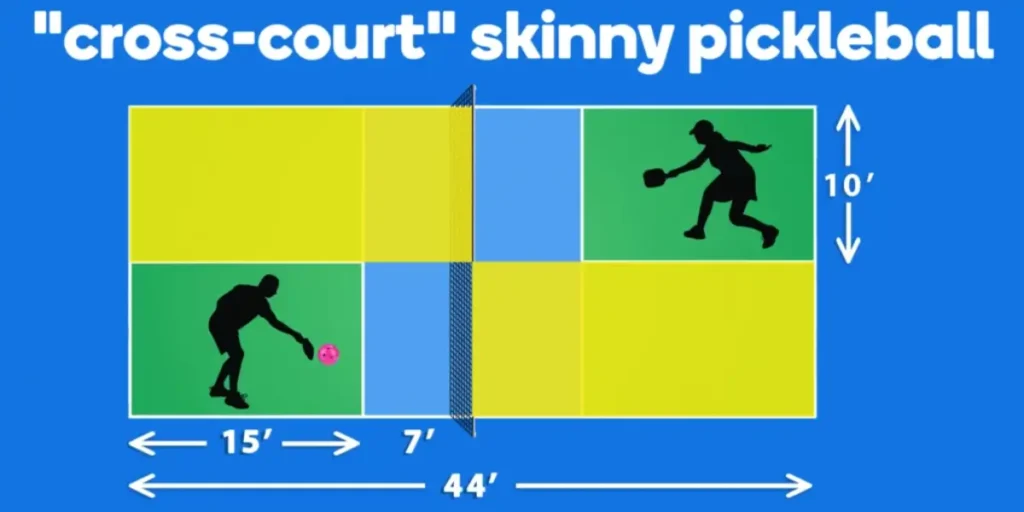
This variation builds directional consistency and depth control. Repeating the same angle sharpens spin management and sideline awareness. Players learn to move efficiently along the non-volley zone while staying balanced.
Extended dink exchanges improve patience and touch under pressure, which makes this format highly valuable for competitive players.
Same Side Skinny Singles
Both players compete on the same side of the court, often backhand to backhand. This setup exposes technical weaknesses and removes safe escape options. Players must develop stable mechanics and clean contact, which builds stroke reliability and confidence.
Competitive Skinny Singles
Some players treat skinny singles as a true match format with official scoring and structured point play. Faster rallies demand quick decisions and strong tactical discipline.
Why Play Skinny Singles Pickleball?
Skinny singles is more than a space-saving drill. Players use it because it delivers fast, measurable improvement. The reduced court forces precision and exposes habits that often go unnoticed in full court play.
1. Improves Shot Accuracy
Skinny singles demand intentional placement on every rally. With only half the court available, you must control direction and margin carefully. Deep crosscourt returns require proper net clearance and controlled spin. Repetition sharpens accuracy and reduces unforced errors.
2. Strengthens Footwork and Balance
Movement becomes compact and technical. Instead of scrambling, you rely on small, balanced adjustment steps near the non-volley zone. This builds efficiency and translates into stronger positioning during doubles and full singles matches.
3. Develops Strategic Discipline
With no down-the-line escape, players must construct points patiently. You learn when to attack short balls and when to reset with a controlled dink. Tactical awareness improves as you recognize patterns earlier in rallies.
4. Builds Consistency Under Pressure
Crosscourt exchanges often extend rallies. Players who manage depth protect the kitchen line and avoid rushed decisions usually win. Skinny singles reward patience, focus, and high percentage shot selection.
Skinny Singles vs Regular Singles Pickleball
| Feature | Skinny Singles | Regular Singles |
|---|---|---|
| Court Coverage | Half court only | Full court width |
| Movement Demand | Compact and controlled | Extensive and athletic |
| Primary Focus | Accuracy and angles | Depth and court coverage |
| Rally Pattern | Mostly cross-court exchanges | Crosscourt and down the line |
| Training Value | Skill refinement | Match simulation |
5 Tips to Win Skinny Singles Pickleball
Target deep crosscourt returns whenever possible. Depth immediately places your opponent under pressure and limits their ability to step forward. In skinny singles, the crosscourt channel is everything.
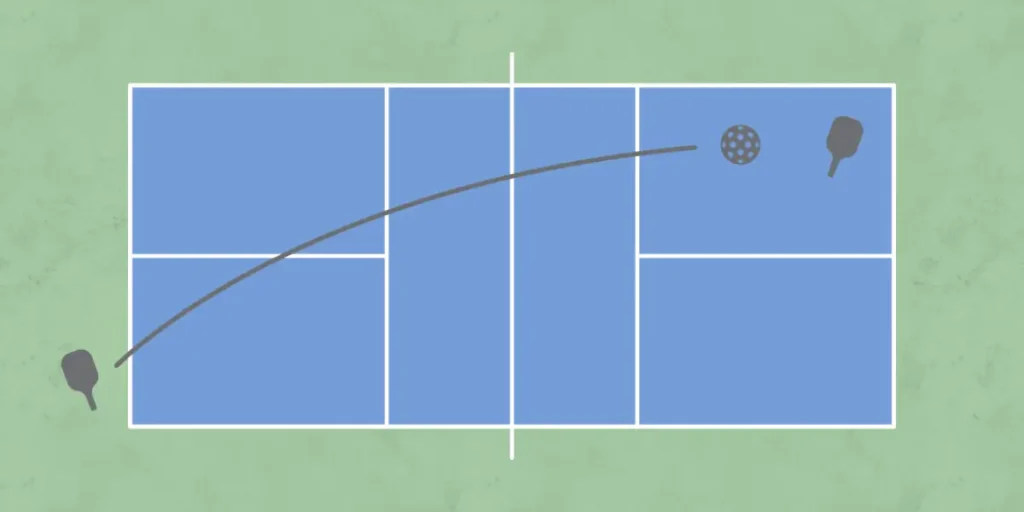
If you consistently push the ball near the baseline, you control tempo and create weaker replies. Many advanced players treat this as a built-in crosscourt control drill that sharpens placement under match conditions.
Attack short balls quickly but stay balanced. Because the court is narrow, hesitation often costs the point. When your opponent leaves a return short inside the service box, step in with controlled pace and aim through the open angle. Avoid reckless swings. High percentage acceleration wins more points than low margin power.
Control the Non-Volley Zone with discipline. Strong skinny singles tactics revolve around owning the kitchen line without rushing forward blindly. Move up behind a solid third shot and establish stable positioning.
From there, use compact swings and keep your contact point in front of your body. Players who dominate this area dictate most rallies.
Use topspin for safety and margin. A controlled topspin drive or roll keeps the ball inside the sideline while allowing you to swing confidently. Spin adds shape to your shots and reduces flat errors that sail wide in the restricted half-court.
Stay patient in dink rallies. Skinny singles reward consistency over impulse. Wait for a ball that rises above the net height before attacking. Smart pickleball strategy in this format focuses on constructing points rather than forcing them.
Common Mistakes to Avoid in Skinny Singles
- Hitting down the line out of habit. In standard cross-court skinny singles, any ball that crosses into the unused half is out. Many players lose easy points because they forget the boundary restriction.
- Standing too close to the center line. Poor spacing reduces your reaction time and exposes the sideline. Maintain balanced positioning inside your assigned half.
- Overhitting due to limited space. Players often swing harder than necessary. Controlled placement wins more rallies than raw pace in this format.
- Ignoring depth on serves and returns. Short balls allow your opponent to step forward and control the non-volley zone early.
- Rushing to the kitchen without a quality approach shot. Advancing behind a weak third shot leaves you vulnerable to passing angles.
- Forcing attacks during dink exchanges. Impatient decisions lead to unforced errors. Wait for a ball above net height before accelerating.
- Neglecting footwork fundamentals. Small adjustment steps and stable balance are essential since recovery space is limited.
Who Should Practice Skinny Singles?
Skinny singles benefits players at every level because it isolates essential skills without changing core match rules. The format adjusts easily to different training goals, which makes it highly efficient.
Beginners develop consistency in a controlled setting. The reduced court simplifies movement and helps new players focus on clean contact and directional control. Repetition builds confidence quickly.
Intermediate players sharpen control and cut down unforced errors. Repeated cross-court exchanges improve depth spin and patience while encouraging smarter shot selection.
Doubles players strengthen crosscourt dinks and kitchen positioning since most competitive rallies develop diagonally.
Advanced players refine third shot accuracy and transition discipline. Limited space punishes weak execution and demands precise decision-making under pressure.
FAQs
Skinny singles is not an official tournament category under USA Pickleball rules. Players use it primarily as a training format. It follows standard court dimensions and scoring, but restricts play to one half of the court for skill development purposes.
Yes, it follows standard serving mechanics, scoring structure, and non-volley zone rules. The two-bounce rule still applies, and only the server earns points. The only major adjustment is that rallies must remain inside the designated half of the court.
Absolutely. Most doubles rallies develop crosscourt, which mirrors skinny singles patterns. Practicing controlled dinks depth management and kitchen positioning in a restricted space directly strengthens doubles consistency and decision making.
Yes, beginners benefit because the reduced court simplifies movement while reinforcing directional control. It allows new players to focus on clean contact and rally structure without the physical demands of full singles coverage.
Conclusion
Skinny singles in pickleball may look like a simple half-court variation, yet it delivers serious results when practiced with purpose.
By limiting space, it forces players to focus on depth control, angle management, and disciplined movement. Every rally demands precision and exposes mistakes quickly, which accelerates improvement.
Whether you are building consistency, refining crosscourt patterns, or sharpening third shot execution, skinny singles creates structured repetition without changing standard rules. It builds habits that transfer directly into competitive singles and doubles play.
The court may be smaller, but the impact on your overall pickleball strategy and performance is significant.